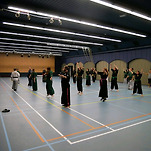
<p style="text-align: left;"></p><div class="figure-img" data-ke-type="image" data-ke-style="alignCenter" data-ke-mobilestyle="widthOrigin"><img src="https://t1.daumcdn.net/cafeattach/17RPA/b24530bcadee892006704fc8b23fbde4a094fe98" class="txc-image" data-img-src="https://t1.daumcdn.net/cafeattach/17RPA/b24530bcadee892006704fc8b23fbde4a094fe98" data-origin-width="1080" data-origin-height="1440"></div><p style="text-align: left;"><br>Dutch Seminar 2026 feedback,<br>written by Frederick Van de Bunt in the Netherlands 🇳🇱 ;<br><br><span style="color: #006DD7;">Single Sword session:</span><br><br>I thought returning to the fundamentals was an excellent way to begin the seminar. <br><br>Revisiting how to hold the sword correctly, paying attention to the subtle details of finger placement, maintaining continuous movement, and using the left hand to support and lift the sword were all valuable reminders. <br><br>These are details that are easily overlooked over time but form the foundation of good swordsmanship.<br>Afterwards, we progressed into the stances and the upper and lower blocking exercises. <br><br>At this point, I felt the pace of the lesson increased quite rapidly. Some participants, particularly those with less experience, seemed to struggle to keep up. <br><br>Slowing down slightly and providing a bit more explanation about why these movements are important could help participants understand not only the mechanics but also the purpose behind them.<br><br>It was mentioned that higher Dan practitioners were already familiar with these movements. Personally, however, I had never practised some of these details during my regular weekly lessons, so even for experienced practitioners they were valuable insights.<br><br>Afterwards the participants split into smaller groups. I was paired with Master Lee from Haedong Kumdo Germany. <br><br>This was one of the highlights of the seminar for me. She gave me detailed feedback on Forms 11 and 12, as well as on my stances, feedback I had been hoping to receive for quite some time. I believe this format allowed everyone to receive instruction appropriate to their own level and greatly increased the educational value of the seminar.<br><br><span style="color: #006DD7;">Double Sword session:<br><br></span>Because of an injury to my right arm, I was initially somewhat concerned about participating in the Double Sword session. Fortunately, I was able to complete the training.<br><br>Before the seminar I expected this session to focus primarily on the double sword forms. Instead, there was a stronger emphasis on Kyuk Kum exercises. <br><br>Although I enjoyed these exercises and found them useful, I had expected Kyuk Kum to be covered more extensively during Sunday's sparring session.<br><br>This is perhaps a personal preference, but I believe there are many technical details and subtle differences within the double sword forms. <br><br>A seminar provides a unique opportunity to refine these details and deepen our understanding of the forms.<br><br><span style="color: #006DD7;">Sparring Session:<br></span><br>Prior to the seminar I expected this session to focus primarily on Kyuk Kum rather than sparring with foam swords.<br><br>The foam sword exercises were enjoyable and served as a good warm-up before the tournament. Personally, however, I felt that this part could perhaps have been shortened or partially replaced by additional Kyuk Kum instruction.<br><br>This opinion is likely influenced by my own background, as I already have considerable tournament and sparring experience in Historical European Martial Arts using steel swords.<br><br> Nevertheless, I always try to approach every seminar with an empty cup, because there is always something new to learn.<br><br>The movement exercises themselves were very interesting and encouraged creative footwork and tactical thinking. <br><br>Some of these movements, however, are not techniques that I realistically expect to see used frequently during tournament sparring, where exchanges often develop much faster and under greater pressure.<br><br><span style="color: #006DD7;">Overall Seminar Feedback<br>Sound:</span> <br><br>Personally, I had no difficulty hearing the lectures and demonstrations, perhaps because I stood relatively close to the front together with the higher coloured belts.<br><br>Several beginners mentioned afterwards that they sometimes struggled to hear the explanations while standing at the back of the hall.<br><br>For future seminars it may be worth considering a microphone or small sound system.<br><br><span style="color: #006DD7;">Pace: <br><br></span>Throughout several parts of the seminar, the pace occasionally increased quite quickly. <br>A slightly slower progression, combined with more explanation about the reasoning behind certain movements, could make the material more accessible for practitioners of every level.<br><br><span style="color: #006DD7;">Overall Impression<br></span><br>Overall, I found the seminar to be both inspiring and educational. I learned many valuable details that I can continue working on during my own training.<br><br>The experience has motivated me to consider attending the upcoming seminar in Bonn this autumn and attending the Belgium Seminar in spring 2027.<br><br><br><span style="color: #006DD7;">Tournament<br></span><br>Organising an event of this scale requires considerable effort from instructors, referees and volunteers, and I appreciate the work that was invested.<br><br>The observations below are intended as constructive reflections.<br><br>Tournament organisation within the Dutch Haedong Kumdo community is still developing, and I hope these comments may contribute to its continued improvement.<br><br><span style="color: #006DD7;">Refereeing<br></span><br>One area that deserves particular attention is refereeing, because unlike the performance of individual competitors, the quality and consistency of refereeing influences the outcome of every match throughout the tournament. <br><br>Good officiating is therefore one of the most important foundations of a fair competition.<br><br>During this tournament I observed that several referees appeared relatively inexperienced. <br><br>This is completely understandable, as tournament refereeing within the Dutch Haedong Kumdo community is still developing.<br><br>During several matches I noticed moments where referees appeared hesitant when deciding whether points should be awarded. <br><br>I also observed Master Chris stepping in on several occasions to assist or clarify situations, demonstrating how demanding the role of referee can be.<br><br>After reviewing recordings of both my own matches and those of other competitors, I observed several situations where I believed valid scoring techniques had not been awarded. <br><br>These included strikes to legal target areas such as the arm or elbow that, from my perspective, appeared to satisfy the scoring criteria.<br><br>Reviewing my own matches also made me realise how significantly refereeing can influence the final standings of a tournament. <br><br>Although I personally believe some decisions affected my own results, this is not my primary concern. <br><br>My motivation for competing is not winning a trophy, but improving my skills and testing myself under pressure. <br><br>However, precisely because refereeing can have such a significant impact on the outcome, it is essential that competitors have confidence that decisions are made as consistently and fairly as possible. <br><br>Fair refereeing is not only important for the competitors who lose points, but also for those who receive them.<br><br>A victory should feel meaningful because both competitors and spectators can trust that the result reflects the performance inside the ring.<br><br>Whether these situations resulted from viewing angle, positioning, interpretation of the rules or simple human error is impossible to determine afterwards. <br><br>Refereeing fast-moving sword exchanges is extremely challenging.<br>Rather than viewing these moments as criticism of individual referees, I believe they highlight the importance of continued referee education, practical experience and standardisation.<br><br>As our community continues to grow, maintaining confidence in fair competition becomes increasingly important, particularly within a relatively small community where competitors, instructors and referees often know one another personally.<br><br>This is not intended as an accusation towards anyone. Instead, it is an invitation to continue improving transparency, consistency and open discussion regarding tournament officiating.<br><br>Intensity During Competition<br>After my second match I received the criticism that I had used excessive force and that I should have adjusted my intensity more to the experience level of my opponent.<br><br> It was suggested that stronger contact could discourage new participants from competing in future tournaments.<br><br>I took this feedback seriously and reviewed the footage several times in an attempt to analyse the exchanges as objectively as possible.<br><br>My conclusion was that the situations in question were not the result of intentionally overpowering my opponent with brute force, but rather of differences in timing, distance, movement, experience and the natural mechanics of the exchange.<br><br>This raises an interesting question for our growing Haedong Kumdo community:<br><br>To what extent should an experienced competitor adapt their intensity to a less experienced opponent?<br><br>Safety and mutual respect should always remain the highest priority. <br><br>At the same time, competition means entering the same arena under the same rules. <br><br>Experienced competitors certainly have a greater responsibility to demonstrate control, but every participant also accepts the realities of speed, timing, pressure and unpredictability that are inherent in competitive sparring. That to hit someone else, is also expect to be hit.<br><br>This also raises another question.<br>If the situation had been reversed and my opponent had landed the same technique on me, would the expectation have been that I should simply have defended better because of my greater experience?<br><br>Experience certainly brings additional responsibility, but responsibility should apply equally to everyone involved.<br><br>Maintaining one consistent standard for all competitors helps preserve both fairness and confidence in competition.<br><br>Personally, I believe that the quality and consistency of refereeing has a far greater influence on whether new participants enjoy competition and feel encouraged to return than the level of contact itself. <br><br>Competitors generally accept that sparring involves being struck within the rules. What builds long-term confidence is the belief that matches are officiated fairly, consistently and transparently.<br><br>For that reason, I consider referee development one of the highest priorities for future tournaments.<br><br><br>Final Thoughts of the tournament<br>Overall, I thoroughly enjoyed the tournament.<br><br>The weekend strengthened my enthusiasm for Haedong Kumdo and reinforced my motivation to continue improving both as a practitioner and as a contributing member of our community.<br><br>I believe Dutch Haedong Kumdo has grown significantly over the past years, and with continued investment in education, referee development and open discussion, future seminars and tournaments will only continue to improve.<br><br>I hope these observations may be useful in the continued development of Haedong Kumdo.Kemu & healing session:I wasn’t present at this session.<br><br>Tournament & Referee Workshop<br>Prior to the seminar, Dominique organised a referee workshop in which participants could experience different officiating roles during sparring matches.<br><br>I found this workshop extremely valuable and believe it should continue to be part of future events.<br>During the workshop, another student (Leonoor) and I discussed openly in the group the current scoring procedure used during Haedong Kumdo tournaments.<br><br>To be clear, my observations are not based on an attempt to project Historical European Martial Arts rules onto Haedong Kumdo. The rulesets are different and should remain different. However, certain principles of officiating are universal across competitive sword fighting.<br><br>One observation was that the centre referee currently carries a significant amount of responsibility. In very fast exchanges it is impossible for one individual to observe every action from every angle.<br><br>Many international sword sports therefore make use of three or four side judges in addition to the centre referee. Multiple viewing angles reduce the chance of missed techniques and help create greater confidence in the scoring process.another concept I also discussed is the concept of the afterblow, a principle that is well known in Historical European Martial Arts.<br><br>In a real sword encounter, bringing an opponent to the ground or landing a decisive strike does not necessarily mean the danger has passed. <br><br>Even while falling, an opponent's sword may still be in motion and capable of delivering a final strike. In HEMA this is referred to as the afterblow.<br><br>Because of this, competitors are encouraged not only to focus on landing a successful attack, but also to immediately defend themselves afterwards and move to a safe distance. In many HEMA tournaments, failing to protect yourself against the afterblow can reduce or even negate the value of an otherwise successful attack.<br><br>I find this concept particularly valuable because it reinforces an important martial principle: a technique is not truly complete until the practitioner has also regained a position of safety. It encourages balanced swordsmanship, where defence, distancing and control remain just as important as offensive actions.<br><br>My intention is not to compare Haedong Kumdo and HEMA as better or worse systems. <br><br>My intention is only to share observations from another competitive sword discipline that may offer useful perspectives. <br><br>The rulesets serve different purposes and should remain distinct. <br><br>However, I believe that the underlying principle, rewarding fighters who maintain awareness and control after scoring, could be an interesting topic for future discussion as competitive Haedong Kumdo continues to develop.<br><br>During the workshop, Leonoor and I shared these observations alongside some of our other thoughts on tournament officiating. <br><br>We left with the impression that most aspects of the officiating system had already been decided beforehand, so there was limited opportunity to explore alternative ideas or discuss them in greater depth. <br><br>For future workshops, it might be valuable to create a little more space for open discussion and exchange of experiences, particularly from participants who have officiated or competed in other sword sports.<br><br>This may be worth exploring as Haedong Kumdo tournaments continue to develop.<br><br>For reference, below is an example of a European sword fighting tournament (the kind of tournament fights where I also contested in) illustrating the use of multiple officials during a match:<a href="
https://www.youtube.com/watch?v=3mRz7GSE78A" target="_blank" class="ke-link"><br>https://www.youtube.com/watch?v=3mRz7GSE78</a><br>I do not suggest copying this system directly, but rather using it as inspiration when considering future development of Haedong Kumdo tournament officiating.<br><br>------<br><span style="color: #006DD7;"><span data-ke-size="size20">Growing Together Through Honest Feedback</span><br><br><i>Thoughts on Frederick's Reflections on the Netherlands Seminar</i></span><i><br><br>One point I would like to add concerns the sparring session.<br><br>Some participants expected to learn more practical fighting techniques.<br><br> However, that was not the primary purpose of this particular seminar.<br><br>Because we had participants ranging from beginners to senior black belts training together, I chose to focus on what I believe is the most important foundation of all martial arts—maintaining balance and controlling the body's center.<br><br>The stepping exercises we practiced were not designed as tournament fighting footwork. <br><br>Instead, they were intended to help practitioners develop the ability to naturally recover and maintain their center of balance in any situation.<br><br>If the body learns to find its own balance automatically, correct techniques can emerge much more naturally. This principle remains just as important for a beginner as it does for a master after many decades of training.<br><br>There is another point I would like to mention.<br><br>In Jinyoung Ssangkum Ryu, sword techniques alone are not enough to understand the art completely.<br><br>Our training also includes Ki Mu and Healing, because they reveal the common principles connecting technique, philosophy, body mechanics, breathing, awareness, and the natural flow of energy.<br><br>Only when these elements are experienced together does the deeper meaning of our practice begin to unfold.<br><br>Frederick is still a color belt, but I was pleased to see that his observations showed careful thought and an open mind. <br><br>His perspective is already different from many practitioners at a similar level, and I appreciate the sincere and constructive way he shared his ideas.<br><br>I hope he continues to train with dedication, earns his black belt, and gradually comes to experience what Ki Mu and Healing truly mean within Jinyoung Ssangkum Ryu. <br><br>I believe this understanding will not only deepen his swordsmanship, but also broaden his understanding of the philosophy that supports it.<br><br>Thank you again, Frederick, for taking the time to write such thoughtful and constructive feedback.<br><br>Keep learning, keep questioning, and keep growing. The journey has only just begun.<br><br>----<br>July 11, 2026<br>JS Kim <br><br></i></p><div class="figure-img" data-ke-type="image" data-ke-style="alignCenter" data-ke-mobilestyle="widthOrigin"><img src="https://t1.daumcdn.net/cafeattach/17RPA/f32c54464f2a6354f1d2a09c4b7528665e9ca8f5" class="txc-image" data-img-src="https://t1.daumcdn.net/cafeattach/17RPA/f32c54464f2a6354f1d2a09c4b7528665e9ca8f5" data-origin-width="1028" data-origin-height="986"></div><div class="figure-img" data-ke-type="image" data-ke-style="alignCenter" data-ke-mobilestyle="widthOrigin"><img src="https://t1.daumcdn.net/cafeattach/17RPA/be716df682af78cbd8fd24d5cf7505936acc8e70" class="txc-image" data-img-src="https://t1.daumcdn.net/cafeattach/17RPA/be716df682af78cbd8fd24d5cf7505936acc8e70" data-origin-width="1035" data-origin-height="954"></div><div class="figure-img" data-ke-type="image" data-ke-style="alignCenter" data-ke-mobilestyle="widthOrigin"><img src="https://t1.daumcdn.net/cafeattach/17RPA/c587cb486b9cc79ec4fabe012e115388c8738122" class="txc-image" data-img-src="https://t1.daumcdn.net/cafeattach/17RPA/c587cb486b9cc79ec4fabe012e115388c8738122" data-origin-width="1078" data-origin-height="1080"></div><div class="figure-img" data-ke-type="image" data-ke-style="alignCenter" data-ke-mobilestyle="widthOrigin"><img src="https://t1.daumcdn.net/cafeattach/17RPA/9b419cdee097fd4a370d85cf48d8af86a45065a7" class="txc-image" data-img-src="https://t1.daumcdn.net/cafeattach/17RPA/9b419cdee097fd4a370d85cf48d8af86a45065a7" data-origin-width="1079" data-origin-height="865"></div><p style="text-align: left;"><i><br></i></p>
<!-- -->