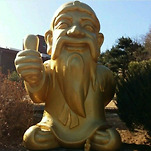
<p style="text-align: left;">눈썹에 붙인 화두를 단박에 떨구게 하는 여자<br><br><br>This poem, titled 화두 (Hwadu), captures a humorous yet poignant moment of human fallibility within a spiritual context. <br><br>Here is the transcription and a breakdown of its meaning.<br><br><br>​Transcription (Korean)<br><br><br>​화두<br><br>이정현<br><br><br>​새벽 예불을 마치고<br>'이 뮛고'<br>화두 눈썹 위에 붙인 채<br>스님은 세수하고 밥 먹는다<br><br>바람이 세찬 날엔 자꾸 눈썹에 손이 가<br>'이 뭣고' 더듬어보니<br>3음절이 다행히 눈썹 위에 붙어있는데<br>​빵빵<br>저만치 외제 차에서 내리는 낯선 여자<br>순간<br>'이 뭣고'<br>화두가 눈썹 밑으로 뚝 떨어진다<br>​아차<br>스님 또 '여자'에 걸려 넘어지시네<br><br><br>​Translation (English)<br><br>​Hwadu (The Zen Koan)<br><br>​After finishing the dawn service,<br>with 'What is this?'<br>stuck above his eyebrows as a Hwadu,<br>the monk washes his face and eats.<br>On days when the wind is fierce, his hand keeps going to his brow;<br>fumbling for 'What is this?',<br>he is relieved to find those three syllables still stuck there.<br>​Honk, honk<br>A strange woman gets out of a foreign car in the distance.<br>In that split second,<br>'What is this?'—<br>the Hwadu drops straight down from his eyebrows.<br>​Oops,<br>the monk has tripped over a 'woman' once again.<br><br><br><br><br>​Key Concepts and Analysis<br><br>​화두 (Hwadu / Koan): In Seon (Zen) Buddhism, a Hwadu is a central question or paradox used in meditation to exhaust the logical mind. The specific phrase used here, '이 뭩고' (I mwot-go), is a classic Gyeongsang-do dialect variation of "What is this?"—one of the most famous Hwadu in Korean Buddhism.<br><br>​The Metaphor of the Eyebrows: The poem personifies the Hwadu as something physically "stuck above the eyebrows," representing the monk's constant focus and mental discipline. Even the wind can't shake his concentration.<br><br>​The "Fall": The "honk" of the car and the appearance of a "strange woman" represent the sensory distractions of the secular world. The Hwadu dropping from his eyebrows signifies a sudden loss of mindfulness.<br><br>​The Wit: The ending "tripped over a woman" is a playful jab at the monk's struggle to maintain detachment. It suggests that despite his rigorous morning practice, the human instinct and the distractions of modern life (symbolized by the "foreign car") are powerful enough to break his meditative seal.<br><br>​It’s a delightful piece that highlights the "everyday" struggle of spiritual practice with a very light, observant touch. Would you like to look at more poems in this style?</p>
<!-- -->