<P>일부인이 아쉬워!? 동봉된 원주의 11th evacuation hospital이라는 사진이 들어있다. 글은 없고.</P>
<P> </P>
<P style="TEXT-ALIGN: center"><img src="https://t1.daumcdn.net/cfile/cafe/273FE63C52D8F1550D" class="txc-image" style="FLOAT: none; CLEAR: none" exif="{}" actualwidth="740" border="0" hspace="1" vspace="1" width="740" id="A_273FE63C52D8F1550DC687"/></P>
<P> <SPAN style="FONT-SIZE: 18pt">1952.7.7. 원주</SPAN></P>
<P style="TEXT-ALIGN: center"><img src="https://t1.daumcdn.net/cfile/cafe/23529A3C52D8F15606" class="txc-image" style="FLOAT: none; CLEAR: none" exif="{}" actualwidth="899" border="0" hspace="1" vspace="1" width="899" id="A_23529A3C52D8F15606E6DB"/></P>
<P> </P>
<BLOCKQUOTE>
<P><SPAN style="FONT-SIZE: 18pt"><FONT color=#ff0000>11th Evacuation Hospital </FONT></SPAN>SMBL A History World War I It was "The War to End All Wars". Starting in 1914 in Europe, it spread through Asia, </P>
<P> </P>
<P> Campaigns: Tunisia, Sicily, Naples-Foggia, Anzio, Rome-Arno, Southern France (with arrowhead), Rhineland, Ardennes-Alsace, Central Europe Decorations: Meritorious Unit Commendation, Streamer embroidered The <STRONG><FONT color=#ff0000>Korean War </FONT></STRONG>The 11th was reactivated at Fort Hood, Texas on May 2nd 1949. Col H.W. Glascock was in command. The balance of the unit was made up of Texas Reservist with a few Oklahoma Reserve members. COL Glascock, believed in hard training for all. Doctors Nurses it didn?t matter they all trained on weapons and field medical training. </P>
<P> </P>
<P><STRONG><SPAN style="FONT-SIZE: 14pt">They immediately embarked on a period of training that was to last until January of </SPAN><SPAN style="FONT-SIZE: 14pt">1951</SPAN><SPAN style="FONT-SIZE: 14pt">.</SPAN></STRONG> Almost one month later, and fresh from training, the unit sailed Camp Sakia Japan to prepare for duty in Korea. The training continues with a new sense of urgency. New personnel arrived daily the 11th was combat ready. The 11th departed Camp Sakia on <STRONG>2 May 1951 </STRONG>for Sasebo Japan. The 11th Evac boarded the Konju Maru ( a Japonese, WWII Troop Ship) and crossed the narrow Sea of Japan to Korea, arriving at Pusan Harbor Korea 3 May 1951 The 11th Evac?s first home in Korea was a tent city just outside Pusan. The stay was short. Orders arrived, the 11th to relocate in Chungju Korea, a small town just south of Wonju (2nd Div HQ-AO) The heave equipment was loaded on a freight train for the move. Two guards for each boxcar were assigned and the train headed North. The Balance of the equipment and personnel officers and enlisted were loaded on trucks and Convoyed to Chungju. Col. Glasscock was the Commanding Officer. The movement by train was interrupted several times by Gorilla activity. This constant interruption keep everyone at a high state of alert. Every time the train stopped, venders would pop out of nowhere to sell the GI their products. Candles, candle holders made out of discarded beer and soda cans. Trinkets of all sorts made from what others have thrown away. We finally arrives at our new location without any American casualties. The convoy took a little longer to arrive at Chungju. They were routed through, Taego, Kumch?on and Sangju. Anyone that was in Korea in the early days, can verify that the roads were in very poor condition. This had to be a rough ride. It was evident from the very first, the 11th Evac came to Korea to make a difference. It didn?t matter what rank a person was, they rolled up their selves and went to work. Their professional manor, enthusiasm, dedication to task at hand, was a sight to behold. Everyone was proud to be a member of this dedicated unit, the 11th Evacuation Hospital (SMBL). Surely "the eyes of Texas" and the world was upon us. A bombed out school building in Chungju became the 11th Evac new home. The first floor housed the OR, Pre-Op, X-Ray, Lab and CMS. Our Nurses were billeted on the second floor. Tents with white liners served as wards. The 11th Evac were taking patients two hours after we arrived. As the patient load increased, more tents were set up. The detachment HQ and mail personnel was located across a dirt road from the hospital area. This was the units only weak point. In order to defend the Hospital assigned members had to cross an open road. The can do attitude of the 11th took care of that problem. Most of the 11th Evac?s patients came from the 2nd ID that were engaging the enemy just north of us in Wonju. Occasionally wounded from the 3rd ID and other units arrived from the battle areas around the 11th AO. It is a sad thing when any soldier has the misfortune of getting wounded. But if the wounded soldier has the good fortune of being sent to the 11th Evac, their chances of survival was increased ten fold. It?s that "can do attitude" coming into play again. Patients arrived at the 11th all hours of the day and night. They arrived by, helicopter, litter-jeep, ambulance, truck even by buffalo drawn carts. All will agree, the chopper played the major role in preservation of lives. Helicopter detachments were equipped with Bell H_13 helicopters; or Hiller H_23s. Each craft carried only a pilot and was equipped with two baskets or pods for litter patients. Under exceptionally good flight conditions, one walking patient could be carried at the same time. Certain expedients adapted the helicopters for evacuation. Plastic bags were used to keep the patients warm. Flexible tubes were fitted from the engine to heat the patients in flight. Covers for the pods were devised to keep the wind off their faces. The fact that the patients in the pods could not receive medical care while in flight remained one of the serious limitations of the helicopter, even though a mechanical device permitted them to be given plasma. The limitation on medical care and the short fuel_range of the craft make it necessary to keep helicopter flights short. Time after time the 11th Evac personnel demonstrated their professionalism and bravery. On one occasion the Orthopaedic Tent caught on fire. <STRONG><U><FONT color=#ff007f>Without hesitation, Officers and Enlisted ran into the burning tent to save the occupants. To compound the situation, most of the patients were in casts, ranging from arm and leg to full body-cast. In August of <FONT color=#0900ff>1951</FONT> the 11th moved to <FONT color=#0900ff><SPAN style="FONT-SIZE: 18pt">Wonju.</SPAN></FONT> Wonju was the original site selected for the 11th back in May 1951. However the area was not secure at the time. </FONT></U></STRONG>The 2nd I D and the Chinese deputed over the ownership of the land. By August the 2nd ID paid dearly for the property and gained full ownership. Is sounds to me that the 2nd ID had some of that "Can Do" attitude. The Artificial Kidney Machine Many wounded soldiers were being treated for acute renal failure and despite the very best care available at the 11th Evac, many died from potassium poisoning. Dr. Lloyd H. (Holly) Smith had been trained in the use of the Kolff Artificial Kidney at Harvard University and Walter Reed Army Hospital. He proposed to our CO. Col. Harold Glascock that we ask that the Walter Reed kidney machine be shipped to Korea so that we could dialyze these patients. Col. Glascock immediately made the request, through FECOM, (Far East Command, Japan). Col. Glascock, cut orders on Dr. Smith to go to Washington, pack up the Walter Reed Kidney and all necessary chemical and electrolyte supplies and bring them back to Wonju and the 11th Evac. Dr Smith was away about two weeks and during this time Col. Glascock had a separate tent unit with its own power generator put together for the dialysis unit. Dr. Smith arrived with everything and the machine was set up and dialysis therapy began at once. Several of our doctors, nurses and technicians assisted to include,. Doctors Robert Abernathy and Robert Hall. Almost at once the 11th began to receive patients from all over Korea. With each dialysis run requiring several hours and so many patients, the difficult decision was who could be treated without dialysis or who would die in spite of dialysis. Col. Glascock was truly a great commander and physician and deserves the credit for the establishment and success of the Dialysis Unit at the 11 th Evac. No doubt that many lives were saved because of the kidney machine Wonju was to be the home of the 11th for the balance of the war. Although the 11th was understaffed and overworked they never lowered their proficiency. Thousand of soldiers from many lands left Korea alive do to ,the combined skills of the 11th dedicated personnel. "A Notre Puissance" (To the best of our ability) was not only their motto, it became their way of life. HEMORRHAGIC FEVER Another interesting chapter in the medical history of the11th Evac Hospital was Epidemic Hemorrhagic Fever. This was a strange infectious disease, spread by ticks, of unknown cause (then) but almost certainly due to Hanta virus. Patients had bloody eyes, up-chucked blood, had hemorrhages in the right atrium of the heart, the stomach and the kidneys. It was generally thought the pathological picture resembled histamine poisoning ? perhaps the responsible organism released histamine. Alternated cases were treated with intravenous benadryl (an anti-histamine) and this appeared to produce good results. Dr. Irwin Hoffman, who had training in pathology, autopsied all the hemorrhagic fever death cases, carried tissue samples to Pusan for histologic study and studied the slides with the pathologists there. It was at Wonju that Brig Gen. L. Homes Ginn Jr. then Eighth Army Surgeon, presented the Meritorious Unit Commendation to the <STRONG>11th Evacuation Hospital on 6 October 1952</STRONG>. The unit was cited for exceptional meritorious conduct in the performance of outstanding service in support of combat operations in Korea during the period 2 May 1951 to 1 June 1952. The commendation was formally received by Col. Fred W. Seymour, Commanding Officer of the hospital. No sooner than the ceremonies died down and night had fallen, many patients arrived, compelling the personnel of the hospital to work 24 hours a day. This heavy demand on hospital personnel continued on for several more months. The peace talks were beginning to make progress. All parties agreed to a prisoner exchange between North Korea ans South Korea.. The 11th Evac prepared for the exchange. The Operation was to be called, "Operation "Little Switch" On 1 July 1953 an Advance party had established a permanent spot at Munsani to store hospital supplies and equipment. <STRONG>The 11th Evac was to be the main unit to handle the medical processing of repatriated United Nations POWs (except Commonwealth and ROK). Long hours of hard work were involved before several dry runs at Old Freed</STRONG>om Village were accomplished. Movement to New Freedom Village was made 1 August 1953. On 3 August the hospital processed 50 returnees. Soon all 3,907 returnees passed through the hospital, General Dean being one of them. The maximum number of returnees processed in any one day was 275. The greatest strength of the forward unit was 220. Operation Little Switch took place in April 1953 followed by operation Big Switch in August and September. The first day the 11th processed 50 Returnees. The total returning Prisoners was 3,907 that included Maj General William Dean who had been a prisoner over three years Some of the noted visitors to the hospital during the POW processing were General Mark Clark, Commanding General Armed Forces Far East Command; General Taylor, Eighth United States Army Commander; General Stuart G. Smith, Eighth Army Surgeon; Secretary of State Mr. John F. Dulles; Secretary of the Army Mr. Stevens; General Stanley, Far East Surgeon; General Weyland; Senator Knowland of California and the President of South Korea, Sigman Rhee and Mrs. Rhee. All were unanimous in their praise of the hospital*s smooth handling of the repatriation of the POWs. 7 September 1953 officially closed the operation. Some of the noted visitors to the hospital during the POW processing were General Mark Clark, Commanding General Armed Forces Far East Command; General Taylor, Eighth United States Army Commander; General Stuart G. Smith, Eighth Army Surgeon; Secretary of State Mr. John F. Dulles; Secretary of the Army Mr. Stevens; General Stanley, Far East Surgeon; General Weyland; Senator Knowland of California and the President of South Korea, Sigman Rhee and Mrs. Rhee. All were unanimous in their praise of the hospital*s smooth handling of the repatriation of the POWs. 7 September 1953 officially closed the operation. On 5 October 1953, a year after the ceremony giving the 11th Evacuation Hospital a Meritorious Commendation, another ceremony took place; a Retreat Review in honor of Colonel Fred W. Seymour as he left for the U. S. and to welcome Lt. Col. Kellogg as our new Commanding Officer. Brigadier General Stuart G. Smith, Eighth Army Surgeon, presented Colonel Seymour with the Legion of Merit for the shining success of Operation "Big Switch". During the period of time that the 11th served in Korea, over 28,000 patients were admitted to the hospital between its arrival in Korea and late October 1953. From this time until midsummer 1954, the 11th Evac at Wonju, continued to serve the valley area treating both UN personnel and civilians. During this period of somewhat relaxed activity, the hospital began to institute long-needed internal improvements. In November 1953 The 11 th Evac received their second Meritorious Unit Citation for the period 2 June 1952 to 7 September 1953. 28,000 patients treated during the fighting. All members are justly proud of the units record. The 11th Evacuation Hospital continued their medical mission in the Winju valley, treating both Un troops and civilians, untill the Summer of 1954. On 4 July 1954, the11th Evacuation Hospital moved to Seoul, on paper, to replace the 46th Evacuation Hospital. All the personnel at Wonju remained to close out the site and to be transferred to other units. The personnel of the 46th remained to take over the colors and name of the 11th. During the summer and fall of 1954, the11th Evac continued the work of the old 45th, that of the treatment and study of Hemorrhagic Fever. Toward the end of summer, Lt. Col. Edward Ricketts, the Commanding Officer, was awarded the Legion of Merit by Brig. General Stuart Smith, in recognition of his work with Hemorrhagic Fever. Colonel Dell F. Dullum arrived during the early part of October to assume command and on 6 October Major General Samuel T. Williams, Commanding General IX Corps and Brig. General Paul I. Robinson, Surgeon, Eighth Army arrived to observe a course of instruction in the treatment of Hemorrhagic Fever. On 11 October a group of officers and enlisted men arrived from Walter Reed Army Hospital. This group was known as The Metabolic Research Team. They rapidly completed their research and departed in December. By January 1955 the Hospital again was back to routine work. The H. F. patients who had contracted the disease in the fall of 1954 had, for the greater part, much improved. It was at this time that the11th began to receive personnel from units that were closing. The 8079 AU Convalescent Hospital moved most of its personnel and patients and thus added new functions and responsibilities to the11th Evac. Finally, in the early part of 1955, the11th was notified that the end of its long and proud service in Korea was at hand. Campaigns: CCF Spring Offensive, UN Summer-Fall Offensive, Seconf Korean Winter, Koreaa Summer-Fall 1952, Third Korean Winter, Korea Summer 1953 Decorations: Meritorious Unit Commendation, Streamer embroidered KOREA 1951-1952 Meritorious Unit Commendation, Streamer embroidered KOREA 1952-1953 </P></BLOCKQUOTE>
<P><BR> </P>
<P> </P>
<!-- -->

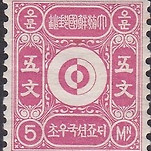



첫댓글 어째서 수입인지을 첨부하였는지 모르겠군요
우표로 간주했을까. 1951년에 발향된 인지인데 장식용인지.... 당시 요금을 분석해야겠어요.